

Consider a contractor completing a project where deliveries repeatedly obstructed a pedestrian route. After several observations and a near miss, the team revised delivery slots, moved the unloading area and checked the arrangements during busy periods. The solution was recorded, the actions closed and the project handed over.
On the next project, a different team encounters the same conflict between deliveries and pedestrian access. The layout is different, but the planning issue is familiar. The previous solution is in a close-out report that nobody reviewed before agreeing the new logistics plan.
The organisation has already paid for that lesson through disruption, investigation and management time. Yet the next team is left to discover it again. Historical safety data becomes useful when it informs a decision before work starts, and remains available when conditions change.
A closed action is not necessarily a lesson learnt
Verified closure shows that the team has addressed a particular finding. Organisational learning asks a further question: does this finding reveal something that other projects need to consider?
That connection is easily lost. Inspection findings remain in spreadsheets, photographs sit in messaging groups and corrective actions are recorded in separate project systems. At demobilisation, access changes and the people who understood the context move on. A monthly total of closed actions preserves little of the reasoning behind them.
The UK Health and Safety Executive’s guidance on learning organisations distinguishes identifying lessons from putting them into practice. It also stresses that organisational memory needs to survive staff and contractor changes. For construction leaders, this means giving lessons an owner and a route into future work, beyond circulating a report.
Find the recurring problem behind different reports
HSE managers need to review observations, incidents, inspections and corrective actions together. A serious incident deserves attention, but repeated low-consequence findings may reveal a control that is routinely difficult to maintain. Include actions that failed or required repeated intervention, as well as those accepted at close-out.
In the delivery example, individual reports might describe blocked access, poor segregation or materials stored outside a designated area. Reviewing each category separately could miss the common issue: delivery capacity and work sequencing were not coordinated. “Remind operatives to keep routes clear” would leave that planning problem unresolved.
Keep enough structure to retrieve findings by activity, work phase, hazard and control failure. Link the original evidence to the action and subsequent verification. A useful lesson explains the conditions, why the control failed, what changed and the evidence that the change worked. Where that evidence is incomplete, say so.
Workers and supervisors supply much of this context. Ask what made the original arrangement impractical and whether the revised one worked during actual operations. Recording their explanation accurately, then showing what management changed, gives reporting a visible purpose.
Use previous lessons to challenge the next plan
A lesson from one project should prompt questions on another. It cannot replace a fresh risk assessment. Site constraints, plant movements, construction methods, subcontractor interfaces and client requirements may all differ.
Before mobilisation, the HSE manager and project manager should review relevant findings with the people preparing the work package. For delivery conflicts, involve logistics, procurement and the affected trades. Check whether the proposed arrangements recreate the earlier conditions, and record which lessons apply, which need adapting and which are not relevant.
The resulting change might sit in a logistics plan, method statement, procurement requirement or subcontractor scope. Identify the person responsible and the point by which it must be agreed. If protected access depends on temporary works or a different unloading arrangement, another toolbox talk cannot provide it.
Repeat the review before major phase changes. A route that worked during structural works may become unsuitable when fit-out deliveries increase. Previous findings should remain accessible to the team making that decision, rather than waiting for the next incident review.
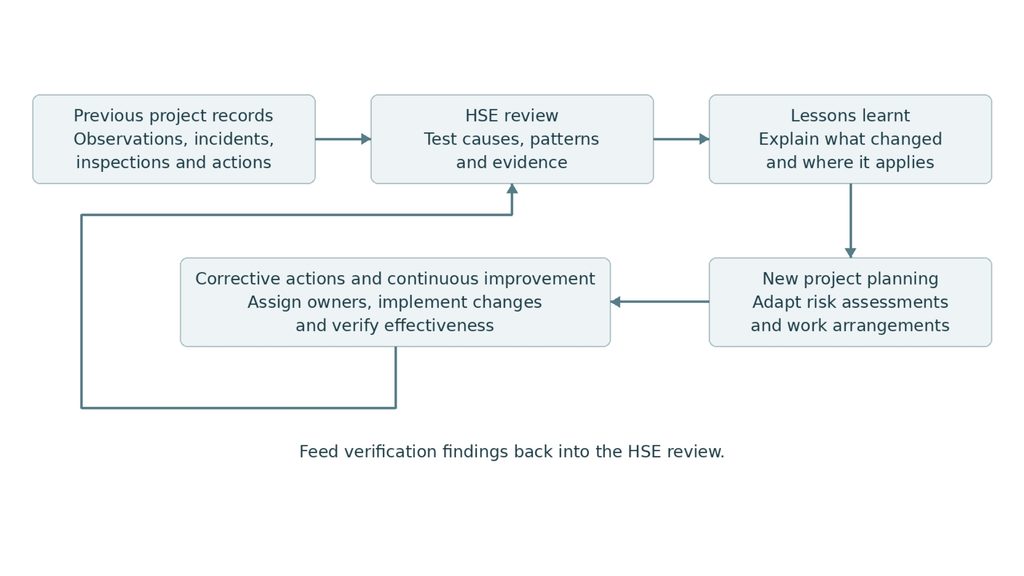
Applying lessons across projects requires a planning decision and a check on the outcome.
Give management something specific to follow up
HSE teams can analyse findings and challenge whether proposed controls address the cause. Project managers need to incorporate agreed changes into delivery arrangements. Leadership must resolve issues that individual projects cannot, such as unsuitable standard details, procurement constraints or recurring gaps in subcontractor coordination.
ADNOC’s 2024 Sustainability Report describes an organisational approach in which significant investigation findings reach senior management, lessons are shared across the Group and corrective actions are monitored. For contractors, the useful feature is the connection between the investigation finding, management review and follow-up on the action.
For a new project, ask the responsible manager to show where an accepted lesson has changed the plan and how its effectiveness will be checked. If an improvement cannot be implemented, record the reason and escalate the unresolved risk. Do not treat distribution of a safety alert as completion of that work.
Better coordination can also reduce avoidable disruption
In the delivery example, planning unloading capacity and pedestrian access together could reduce repeated stoppages, double handling and the need to relocate stored materials. Similar benefits may follow when earlier findings improve trade sequencing or identify access requirements before installation begins.
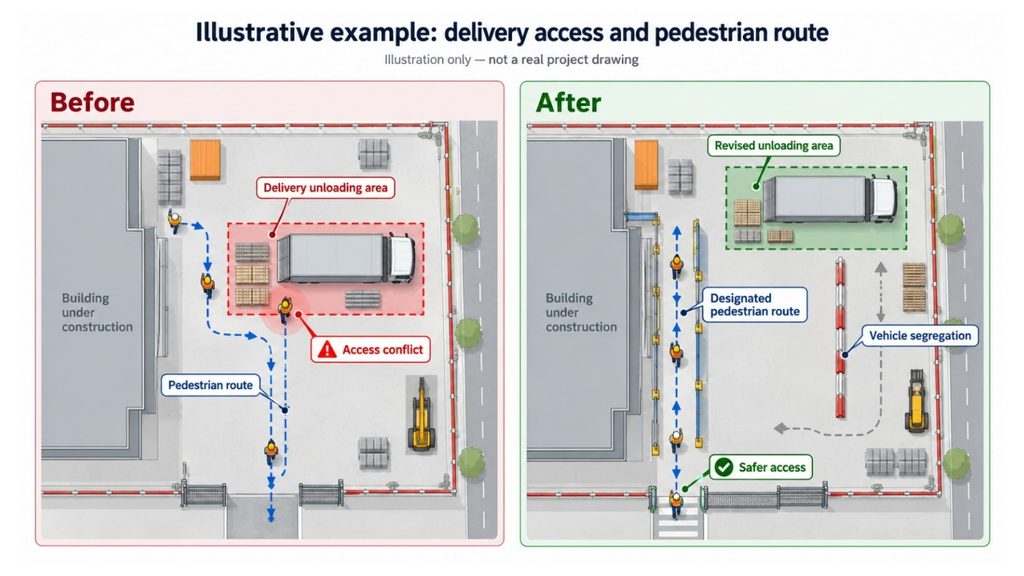
These are potential operational gains, not guaranteed savings. Review repeat findings and control effectiveness alongside relevant delays or rework. Compare similar activities and consider changes in exposure and reporting participation. A fall in observations alone does not establish improvement.
The purpose is to make safe work easier to organise. If a control regularly conflicts with the programme, management needs to examine the arrangement rather than rely on crews to resolve the conflict each shift.
Make safety records usable beyond their original site
Navatech’s nAI Flow supports text and audio observation reporting, assignment for resolution, structured incident records and analysis of incident data across multiple sites. This gives HSE teams a basis for reviewing recurring issues and retrieving information that might otherwise remain in separate conversations.
The HSE and project teams still decide what the evidence means, whether a lesson applies and how plans should change. nAI Flow supports reporting and analysis; it does not automatically prevent incidents or transfer findings into a project’s risk assessments and work plans.
At the next mobilisation review, select one recurring issue from a completed project. Trace it from the original finding to the change that worked, then identify the decision it should influence on the new job. If nobody can show that connection, the lesson is still in the archive.
See how nAI Flow supports structured safety reporting and analysis across sites.