
A supervisor in Riyadh gives a critical scaffolding instruction in English. The Southeast Asian foreman translates it for his crew and who speaks only Bengali & Urdu nods along, unsure of what was actually said. Thirty minutes later, a near-miss incident shakes the site.
Nobody was hurt this time, but the root cause wasn’t carelessness. It was a communication gap that should never have existed.
Language barriers contribute to 25% of all on-the-job accidents globally, according to OSHA estimates.
Source: OSHA / National Institute for Occupational Safety and Health (NIOSH)
The Language Challenge on Gulf Construction Sites
The UAE and Saudi Arabia run some of the most ambitious construction programmes on the planet. Saudi Arabia’s Vision 2030 alone has triggered a pipeline of giga-projects (NEOM, The Red Sea, Qiddiya, and others) worth hundreds of billions of dollars. In the UAE, workplace safety is a growing priority as the country continues to expand its infrastructure and urban development.
What makes these projects unique isn’t just their scale. It’s the people building them. In the UAE, non-citizens make up nearly 90% of the total population, and over 90% of construction workers are expatriates. They come from India, Pakistan, Bangladesh, Nepal, the Philippines, Egypt, and dozens of other countries. Saudi Arabia’s construction workforce follows a similar pattern, with millions of migrant workers from South and Southeast Asia.
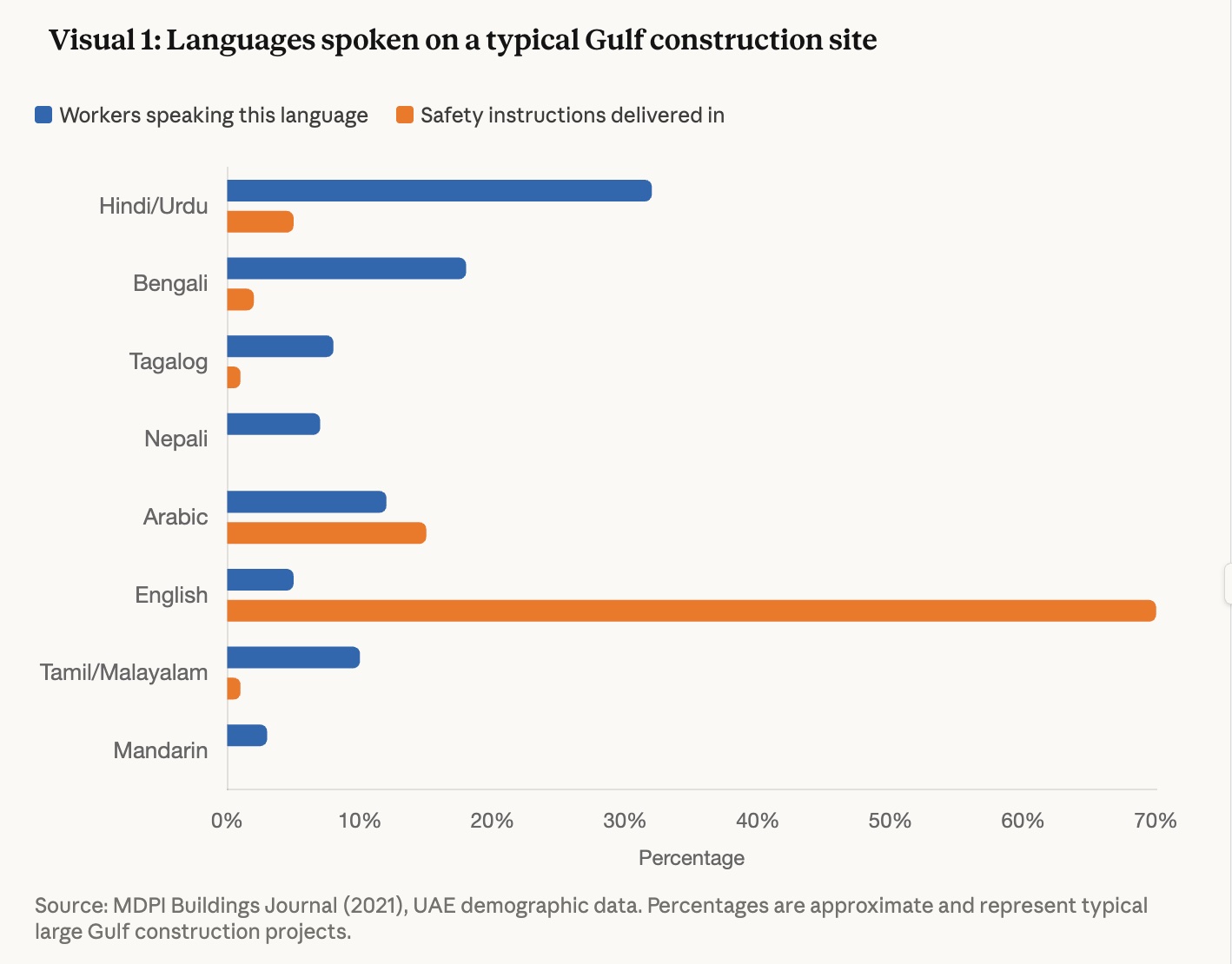
In the UAE, English is used to deliver 70% of safety instructions on construction sites, yet the majority of on-site labourers do not speak or understand English.
Source: MDPI Buildings Journal, 2021 (4-D BIM and VR Study, UAE) – https://www.mdpi.com/2075-5309/11/8/319
Why Traditional Communication Methods Fall Short
Most construction companies in the Gulf region still rely on a handful of bilingual foremen to act as interpreters. The problem with this approach is straightforward: it creates bottlenecks, introduces translation errors, and breaks down completely during emergencies when speed matters most.
Consider the typical safety workflow on a large project. The project safety manager prepares a toolbox talk in English. A foreman translates the key points into Urdu or Hindi for his team. Workers who speak Bengali, Tagalog, or Nepali either get a second-hand summary or miss the message entirely. If a worker spots a hazard and wants to report it, they face the same barrier in reverse. This cycle of multilingual workforce management failure repeats daily on thousands of sites across the region.
Best Practices for Multilingual Safety Communication
Solving multilingual safety communication in construction requires more than just translating a safety manual into five languages. It demands a system-level approach that addresses how information flows across every layer of a project, from the safety manager’s desk to the worker on the scaffold.
Here are the practices that leading contractors and safety-focused companies are adopting on GCC projects:
1. Deploy AI-Powered Real-Time Translation on Site
The single most impactful change a construction company can make is to adopt AI safety translation tools that work in real time. These tools can translate text messages, voice notes, and even images across languages instantly, eliminating the bottleneck of relying on bilingual intermediaries.
Workers can ask a question in Bengali and get an answer in Bengali. A safety officer can send an alert in English and have it delivered in Urdu, Hindi, Tagalog, and Arabic simultaneously.
This isn’t theoretical. We wrote about how AI is already doing this on GCC construction sites in an earlier piece: Breaking Language Barriers on GCC Construction Sites with AI
2. Make Safety Training Multilingual and Multi-Format
A 400-page safety manual in English is practically useless for a worker who reads only in Tamil. Effective migrant worker safety training needs to be delivered in the worker’s native language and in a format that matches their literacy level. That means combining translated written materials with video demonstrations, audio instructions, and hands-on practice sessions.
3. Enable Multilingual Incident and Hazard Reporting
If a worker can only report a hazard in English but thinks in Urdu, you have a reporting gap. Digital safety communication platforms that accept voice notes, text, and photo-based reports in any language remove this friction entirely. The system translates and routes the report to the right safety officer, who receives it in their preferred language.
This two-way flow is critical. Safety isn’t just about pushing information down to workers. It’s about creating channels for workers to push information up. When those channels work in every language spoken on site, incident response times drop and near-miss reporting goes up.
4. Use Visual Communication as a Universal Layer
Pictograms, colour-coded signage, and visual SOPs serve as a safety communication baseline that works regardless of language. ISO 7010 safety signs are designed to be universally understood, and they should be present at every hazard zone. Combined with multilingual text and AI tools, visual communication creates a layered approach where no single point of failure can leave a worker uninformed.
5. Audit Your Safety Communication Regularly
Run quarterly surveys in workers’ native languages to find out whether they actually understand the safety protocols they’ve been trained on. Construction safety best practices include not just delivering training, but verifying comprehension. If 40% of your Bengali-speaking workers can’t explain the site’s evacuation procedure, you don’t have a training problem. You have a communication system failure.
How Navatech Solves This Problem
At Navatech, we’ve built AI-powered solutions specifically for this kind of multilingual, high-risk environment. Our tools integrate directly into the communication channels workers already use, so adoption is immediate and the learning curve is minimal.
nAI Hub: Safety Knowledge in Every Worker’s Language
Workers access safety information through WhatsApp, WeChat, or any messaging app they’re already comfortable with. They can ask questions, share photos of potential hazards, or send voice notes, all in their native language. The AI responds in the same language with site-specific safety guidance. Instead of flipping through an English safety manual, a Nepali-speaking worker simply asks: “के आज यो भर्याङ प्रयोग गर्न सुरक्षित छ? (Is it safe to use this ladder today?)” and gets an immediate, relevant answer in Nepali.
nAI Flow: Turning Communication into Action
Construction teams coordinate through group chats. nAI Flow sits inside those chats and watches for safety-relevant messages. When a worker types in Urdu, the system translates it for the English-speaking safety manager, creates a task, assigns it to the right person, and tracks it to resolution. No manual data entry. No information lost between languages.
Building Safer Sites by Speaking Every Worker's Language
GCC is building the futuristic projects and dozens of other developments are reshaping what’s possible in construction. But the workers making this happen, the millions of migrant labourers from across Asia, Africa, and the Middle East, deserve safety systems that actually reach them.
Multilingual safety communication in construction is not a nice-to-have feature. It’s a fundamental requirement for any project that employs a diverse workforce. When a Thai-speaking electrician can explain a wiring concern to an Arabic-speaking supervisor, who can then relay technical requirements to a Hindi-speaking project manager, everyone benefits. Fewer accidents. Faster response times. Stronger safety culture.
AI-powered tools like Navatech’s nAI Hub and nAI Flow are already proving that construction site language barriers can be eliminated without disrupting existing workflows. The question is no longer whether to invest in multilingual safety communication. It’s how quickly you can get started.
Because every worker on your site deserves to understand the instructions that keep them alive.