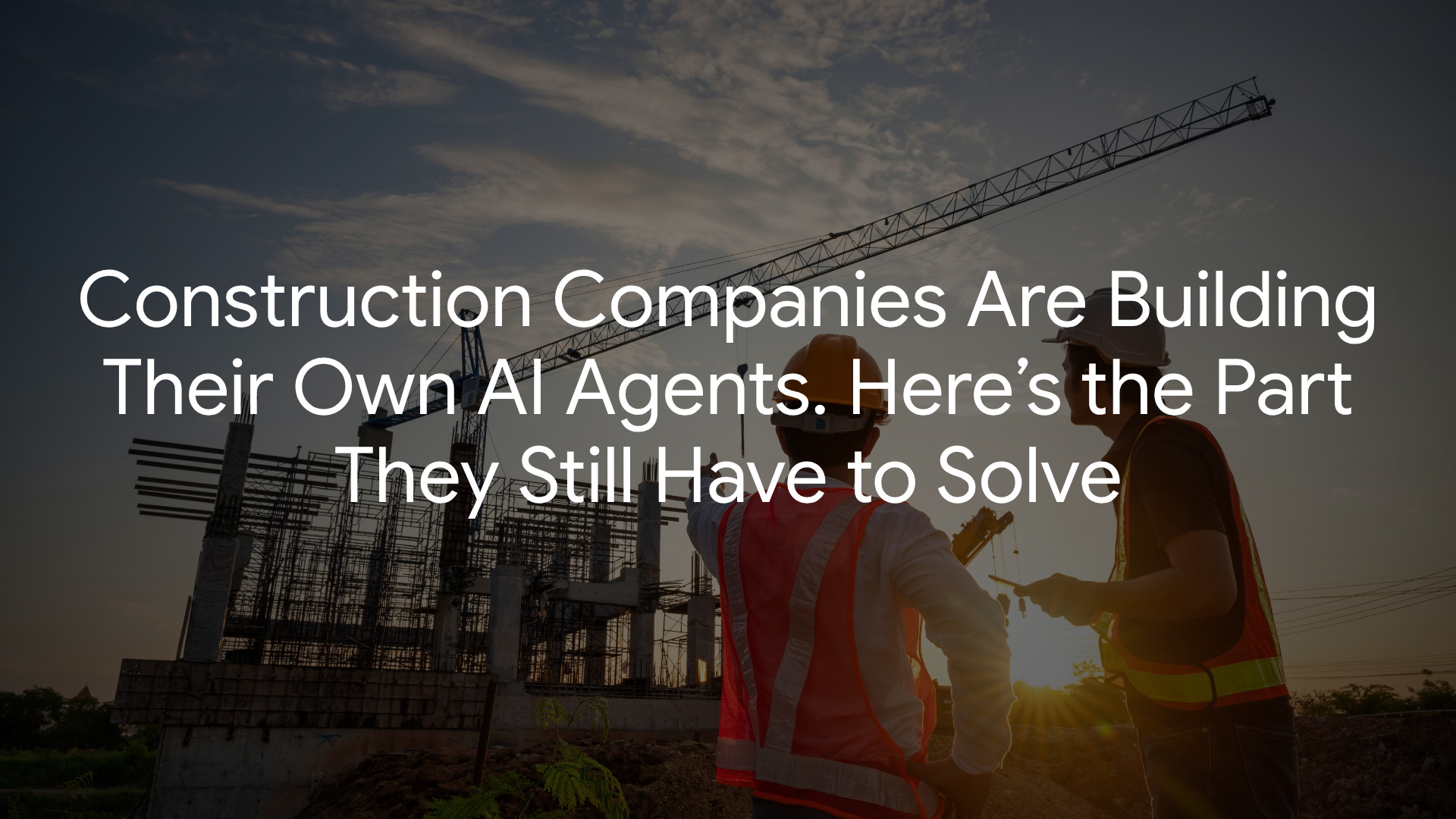

AI use is becoming more common across construction, even though organisational readiness remains uneven. RICS’ 2026 research found that around two-thirds of construction organisations are now using AI, while 37% plan to increase their AI investment. Yet nearly two-thirds still report low levels of AI preparedness, with data quality and integration among the barriers to scaling adoption.
The next step is already taking shape: AI agents that can work across company knowledge, project information and repeatable workflows. Adoption of agents is still early. In Mastt’s 2026 survey of 100+ construction project-management professionals globally, 9.3% of respondents said they were already using AI agents, while 46.3% said they planned to start.
The shift is important. Construction AI is beginning to move from answering questions and summarising information towards systems that can take defined actions across project workflows.But that creates a more fundamental question: what happens when the information that matters never reaches the AI in the first place?
Enterprise knowledge is not the same as live site reality
That question becomes clearer once you separate what the organisation knows from what is actually happening on site.
Enterprise AI is usually strongest where information already exists in a system. Procedures, standards, historical incident reports, project documents, lessons learned, emails and meeting records can all become part of a company’s knowledge environment. An AI agent can search across that information, connect patterns and help people reach an answer much faster than before.
But construction sites do not generate information in neat, structured formats.
The company may have an AI agent capable of searching across thousands of pages of safety procedures, but that capability is only useful if the relevant site signal reaches it with enough context.
Where did it happen? What was observed? Which contractor was involved? Is there an immediate risk? Has anyone been assigned to act?
Construction can have sophisticated AI and still have an input problem
Construction data is created in two very different environments. The first is the enterprise environment, where information lives in document systems, common data environments, email, ERP platforms and project software. The second is the workface, where information is often immediate, informal, visual, multilingual and incomplete.
The second environment is harder.
A safety observation may begin as a photograph with no caption. An incident account may arrive as a three-minute voice note. A worker may know exactly what looks wrong but not know the technical term for it. A foreman may describe the issue in Arabic, Urdu or Tagalog while the HSE workflow expects English. A conversation may contain the one detail that changes the severity of the issue, but that detail never makes it into the final form.
If an organisation’s AI strategy starts only after the information is already inside the enterprise system, it starts one step too late.
The need for multilingual and multimodal input
A worker should not have to translate a safety concern into the project’s reporting language or complete a long form before the system can process it. Sometimes a photo explains the problem best. Sometimes it is a voice note. Sometimes it is a short message in Arabic, Hindi, Urdu or another language used by the workforce.
The useful approach is to combine those signals. A photo shows what is happening. A voice note can explain why it matters. Text can add the location, equipment or contractor involved.
For construction AI, multilingual and multimodal input is not just a convenience feature. It is how more of what is actually happening on site makes it into the system.
Interpretation is only the first half of the job
There is another trap here. Turning a voice note into clean English does not make the site safer.
Once AI has interpreted the signal, the organisation still needs context and workflow. What project did this happen on? Where on the project? Which contractor owns the area? Is the issue a hazard, observation, near miss or incident? How severe is it? Who needs to act? By when? What evidence proves the action is complete?
That is where an AI assistant has to connect into an operational HSE workflow.
For HSE leaders, the useful output is not a clever summary. It is a structured record with ownership, escalation, evidence and close-out. For digital teams, that structured record can then become reliable input for the wider enterprise intelligence layer.
A better architecture for construction AI
A stronger architecture connects distinct layers of the technology stack, with each handling a different part of the information flow.
| Layer | What it needs to do | Typical systems |
|---|---|---|
| 1. Frontline capture | Understand text, voice, images and multiple languages at the point of work. | Site communication, mobile, approved messaging workflows |
| 2. HSE workflow | Add context, classification, ownership, action, escalation, evidence and close-out. | Safety management and construction-specific HSE systems |
| 3. Project systems | Connect the record to project, document, contractor and operational data. | CDE, construction management, ERP and reporting systems |
Enterprise copilots and AI agents can then work with a more complete and structured information base. The frontline system does not need to replace Copilot, the CDE or a project management platform. Its job is to make site reality legible to them.
Specialist AI should complement enterprise AI, not compete with it
This distinction matters because construction firms already have substantial technology estates. Specialist HSE AI is more useful when it works with the contractor’s existing collaboration, project and document systems rather than creating another disconnected information layer.
Specialist construction and HSE AI has a different role. It can deal with the information that generic enterprise assistants are least likely to receive cleanly: a worker’s voice note, a photograph from the workface, a multilingual safety question, an informal observation or the chain of actions that follows.
That structured information can then sit alongside the organisation’s broader knowledge and project data. Specialist HSE AI can help turn frontline safety signals into structured information that the wider enterprise environment can use.
Where Navatech fits
Navatech is designed around this frontline gap. nAI Flow captures safety information from text, voice and images through the Navatech app and supported chat-based workflows, then structures that information into HSE records and routes actions through to resolution. nAI Hub gives workers access to organisation-specific safety information with multilingual, voice and image support.
The useful part is not that another AI can answer another question. It is that a frontline signal can enter a controlled HSE workflow with enough context to be owned, acted on and closed.
Conclusion
AI agents are moving closer to real construction workflows, but their usefulness will still depend on the information they can actually access.
On site, some of the most important information does not begin as a database field or a neatly completed form. It starts with what someone sees, says, photographs or reports in the moment. If that signal loses its context before it reaches the wider project or enterprise system, even the most capable AI agent is working with an incomplete picture.
That is why the first mile of information capture matters. Construction teams need a practical way to turn frontline inputs such as voice, images, text and multiple languages into structured information with the right project context, ownership and follow-through.
The opportunity is not to make every system do everything. It is to connect the layers properly, so frontline reality can feed into HSE workflows, project systems and enterprise AI without losing the detail that made the original signal important.
For construction companies investing in AI, that may be one of the most important questions to solve: how much of what is actually happening on site is making it into the systems their AI depends on?
Your enterprise AI can only work with the information it receives.
See how Navatech connects frontline safety signals to structured HSE workflows.