
Consider a familiar site scenario. A scaffolder notices exposed rebar beside a busy walkway. The reporting form is back in the site office, his shift is nearly over, and explaining the issue in English is difficult. He tells a colleague and intends to report it later, but the observation never reaches the formal safety system.
The hazard was seen. The system simply failed to capture it.
This is a familiar failure pattern in construction site safety management. The issue is not always that hazards go unnoticed. It is that the reporting process creates too much friction between seeing the risk and recording it. The hazard was seen, but the system failed to capture it. The question is not whether workers notice dangers. They do. The real question is whether your reporting system meets them where they are.
The Real Problem with Observation Reporting on Construction Sites
Workers may need to leave the work area, find a supervisor, complete a form, explain the issue in an unfamiliar language, or enter information into a system they rarely use. Reports may also be delayed because ownership is unclear or workers do not see what happens after they raise an observation.
The more steps involved, the more likely useful safety information is lost.
Observation reporting on construction sites has always been a challenge, but not because workers are careless. The industry has a structural problem: the tools and processes designed for reporting simply do not match the reality of how frontline crews work.
How AI-Powered WhatsApp Safety Reporting Actually Works
Let us walk through a real scenario to understand how observation reporting automation transforms a typical site observation:
Step 1: A worker spots a type ladder using in a wrong way. He opens his WhatsApp, takes a photo, and sends it to the project safety group with a quick voice note in Hindi describing the location.
Step 2: AI analyses the image and voice note. Using computer vision and natural language processing, the system suggests the likely hazard category (fall protection, missing guardrail), extracts available location information from the voice note, and translates everything into the project’s primary language.
Step 3: A structured safety record is created automatically. The record includes the hazard category, severity level, location, time stamp, the original photo as evidence, and the worker’s description. No manual data entry required.
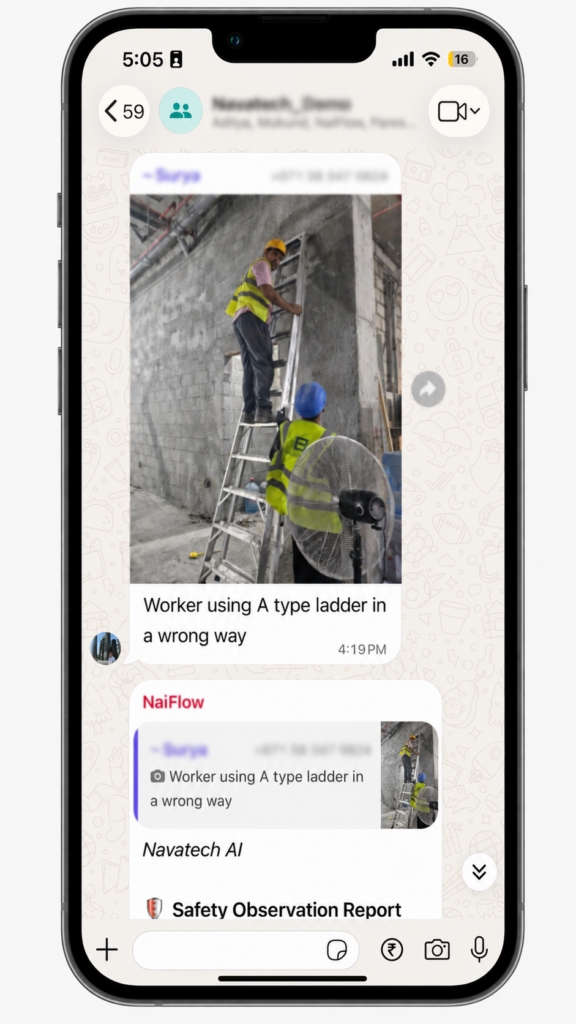
Step 4: The right safety manager is notified immediately. Based on the hazard type and location, the system routes the observation to the responsible HSE personnel with a deadline and escalation path.
Step 5: The action can then be tracked through to close-out. Once the guardrail is installed, the responsible person can upload evidence of the corrective action and complete the record. This creates a clearer evidence trail for future review and audits.
The entire process, from observation to logged record, takes under two minutes. Compare that to the traditional flow where a paper form might take days to reach the safety office, if it reaches there at all.
Why Capturing Every Observation Matters More Than You Think
Herbert Heinrich’s safety pyramid, one of the most cited models in occupational health and safety, established a critical relationship: for every major injury, there are approximately 29 minor injuries and 300 near-miss events (Source: Heinrich’s Safety Pyramid, 1931). This means the base of the pyramid, the unreported observations and near-misses, is where prevention has the most impact.
This is why improving observation reporting on construction sites is not just an administrative exercise. It is a life-saving intervention. Every near-miss captured and addressed is a potential serious injury prevented. And the only way to capture them at scale is to make reporting effortless.
Practical Application: How Navatech.ai Makes This Work at Scale
At Navatech, the philosophy is straightforward: the most powerful safety technology is the one workers actually use. That is why Navatech’s products are built around WhatsApp and the communication channels frontline teams already rely on, rather than requiring them to adopt new platforms.
nAI Hub: A Personal Safety Expert in Every Worker’s Pocket
nAI Hub delivers instant, personalised health and safety support directly through WhatsApp. Workers can ask safety questions, and access company-specific protocols in over 100 languages, through text, voice, or image. It works around the clock, ensuring that safety information is always a message away, regardless of the worker’s language, literacy level, or shift timing. For frontline worker safety technology, accessibility is not optional; it is the foundation. Learn more at navatech.ai/nai-hub
nAI Flow: Turning Group Chats into Safety Intelligence
nAI Flow supports safety observation reporting through approved WhatsApp workflows and the Navatech app. Text, voice notes and images can be converted into structured safety records, reducing the manual effort required to capture and organise field information. When a safety observation is shared in a group, nAI Flow automatically identifies it, creates a structured record, assigns it to the responsible stakeholder, and tracks resolution through to closure. The system includes automatic deadlines, escalation workflows, and complete evidence trails that can be exported for audits with a single click. By turning frontline updates into structured records, nAI Flow can reduce the manual effort involved in compiling, categorising and following up safety information. (Source: navatech.ai/nai-flow).
The key difference: Where WhatsApp reporting is enabled, workers can use a familiar interface rather than learning an entirely new reporting process. If they can use WhatsApp, they can use Navatech. That is not a marketing statement; it is the core design principle that makes adoption rates dramatically higher than traditional safety software.
Five Steps to Improve Observation Reporting on Your Sites
Whether you adopt AI-powered tools or not, here are practical steps every construction company can take to improve observation reporting on construction sites starting this week:
- Audit your current reporting flow from the worker’s perspective. Walk the site with a frontline crew member. Ask them to show you what happens when they spot a hazard. How many steps does it take to log it? How long does the process take? Where does the report go? If the answer involves walking to an office, filling a paper form, or using an unfamiliar app, you have found your bottleneck.
- Reduce the reporting time to under two minutes. The threshold for adoption is speed. If a worker can report a hazard in the same time it takes to send a WhatsApp message, they will do it. If it takes longer, they will not. This is where photo and voice-based reporting through familiar apps makes a measurable difference.
- Reduce language barriers.Large construction sites often include workers who speak several different languages. If the reporting process only works in one or two languages, some workers may struggle to explain what they have seen. Multilingual text and voice support can make it easier for more people to contribute useful safety information.
- Close the feedback loop visibly. Workers stop reporting when they feel nothing happens with their observations. When workers see that observations are acknowledged, acted upon and closed out visibly, they are more likely to continue reporting. A slow or invisible response can have the opposite effect.
- Use data to shift from reactive to predictive. Once observations are captured in a structured format, patterns emerge. You can identify which zones have the most hazards, which types of issues recur, and where the next incident is most likely to happen. This is the shift from construction site safety management as a compliance exercise to safety management as a strategic advantage.
The Future of Safety Reporting is Already in Your Workers’ Pockets
The construction industry does not have an awareness problem. Workers see hazards every day. What the industry has is a capture problem. The gap between what workers observe and what gets formally recorded, analysed, and acted upon is where preventable injuries happen.
Closing that gap does not require million-dollar technology deployments or months of change management. It requires meeting workers where they are, on WhatsApp, in their own language, through the simplest possible interaction, and letting AI handle the complexity of structuring, routing, and tracking.
The companies that will lead construction safety in the next decade are not the ones with the thickest compliance manuals. They are the ones that make reporting a hazard as easy as sending a text message. Because when reporting is effortless, everyone reports. And when everyone reports, sites get safer.
The tools to make this happen exist today. The only question is whether your organisation will be an early mover or a late follower.