

At 8 am, a lifting contractor begins unloading beside Block B, with the operation expected to continue until 9 am and restrict the logistics route. The mechanical, electrical and plumbing (MEP) team has a ductwork delivery scheduled through the same route at 8.30 am. A finishing crew uses the adjacent walkway to reach its work area, but stored materials have narrowed the access.
This illustrative scenario describes a coordination problem, not a reported incident. Each supervisor can see part of the risk. None can independently change every delivery slot, move another contractor’s materials and agree the lifting exclusion arrangements.
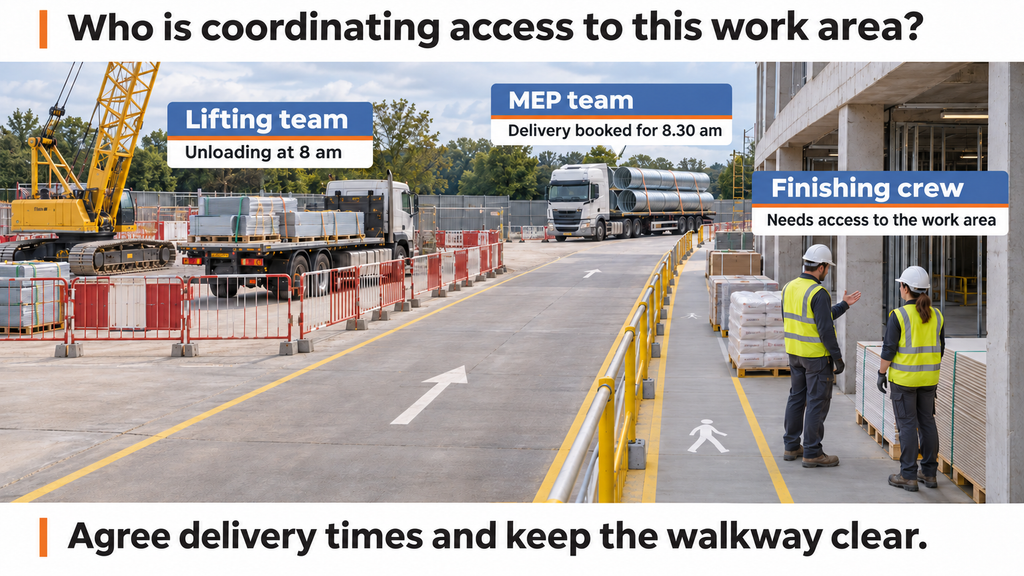
The main contractor’s management team needs to bring those decisions together through the project’s agreed authority structure. Each subcontractor still has responsibilities for its own work. Assigning the observation to one person only helps if the people controlling access, timing and work methods agree what must change.
Record the conflict clearly enough to act
An entry saying “unsafe access” leaves too much unresolved. A useful observation identifies the Block B route, the narrowed walkway, the unloading period, the expected ductwork delivery and the crews affected. A photograph can help show the layout; the timing needs to be recorded separately.
If people could be exposed to danger, use the site’s established stop-work and escalation arrangements immediately. The authorised team must decide which activities or access need restricting while controls are agreed. Submitting a report should never delay an urgent response.
The observation should then reach someone who can coordinate the affected trades. Sending it only to the finishing supervisor because their materials are visible may address the obstruction while leaving two incompatible activities booked into the same route. The review needs to cover the whole work arrangement.
Distinguish record ownership from decision-making authority
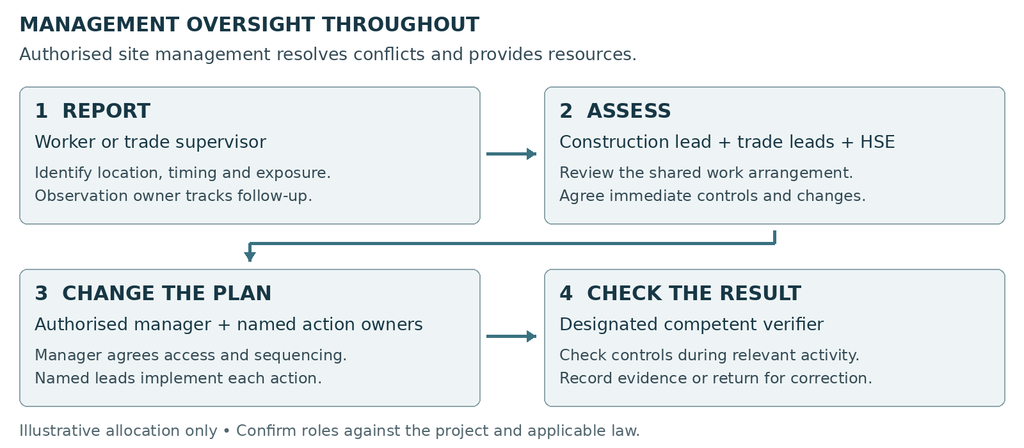
The observation owner keeps the issue moving: confirming details, contacting the relevant people and tracking the agreed follow-up. That person might be an HSE coordinator or another designated team member. The role does not automatically include authority to alter delivery bookings or approve a lifting arrangement.
Corrective-action owners carry out specific changes. In this example, the finishing supervisor arranges removal of the stored materials to an agreed location. The logistics lead changes the delivery booking. The lifting contractor’s competent team reviews its arrangements, while the MEP supervisor confirms how the revised slot affects its work. Each action needs a named owner and a completion point before the affected activity proceeds.
Management accountability concerns the decisions and resources needed to make those actions work together. The authorised construction manager resolves competing demands, agrees the sequence and checks that subcontractor managers can deliver it. Where a decision exceeds that manager’s authority, it needs escalation. HSE provides advice and challenge; an HSE name on the record should not leave operational decisions without an owner.
For projects in Great Britain, HSE guidance on contractors describes their role in planning, managing and monitoring their work in liaison with the principal contractor. HSE separately describes the principal contractor’s role in coordinating health and safety during construction. These CDM references apply to Great Britain. UAE and Saudi projects must establish duties under their applicable local requirements and project arrangements; “main contractor” should not automatically be treated as the same legal appointment.
Agree one workable arrangement across all three trades
Bring the logistics lead, lifting contractor, MEP supervisor, finishing supervisor and relevant HSE support to the route. Review the delivery programme alongside the actual layout. Establish where people need to walk, where unloading will take place and which activities cannot safely overlap.
A possible outcome is to move the ductwork delivery outside the unloading period and clear the pedestrian route before either activity starts. The competent team must also confirm that the walkway remains outside the lifting operation’s required exclusion area. If it does not, a suitable alternative route or a revised work sequence is needed. These are options for site assessment, not a ready-made lifting or traffic plan.
HSE’s site traffic guidance highlights separating pedestrians and vehicles, keeping walkways unobstructed and making routes and instructions clear. Applied to this example, the team needs to check whether the revised access is usable for the finishing crew and whether it creates another conflict further along the route.
Once agreed, update the relevant logistics plan, task documents and delivery instructions. Brief the affected crews in a way they understand, and confirm the change with the gate team and delivery supplier. The arrangement needs a review trigger too: a late vehicle, an extended unloading operation or another trade arriving should prompt the responsible supervisor to reassess the interface before conflicting work proceeds.
Close the action only after checking the work
A photograph of a cleared walkway confirms one part of the correction. It cannot show that the revised delivery slot was communicated or that access remains controlled during unloading. The designated competent verifier should check the agreed controls at the relevant time, without exposing anyone to test them.
The close-out record should explain what changed, who checked it, when the check took place and what evidence supports closure. For Block B, that could include the revised booking, confirmation that crews received the briefing and a site check of the route and exclusion arrangements. If part of the control is incomplete, keep the action open and escalate it through the agreed process.
Structured observations and follow-up, such as those supported by nAI Flow, can help teams keep track of a concern and its response. The project still has to decide who can change the plan and who is competent to verify the result. Software assignment does not transfer legally assigned contractor responsibilities.
At the next coordination meeting, take one recently closed shared-area observation and ask: did the work arrangement change, or was the record merely marked closed? The answer should identify the decision, the people who implemented it and the evidence that the control worked. That is a practical test of whether the hazard has been addressed across all three trades.